.png&w=384&q=75)
Temporary SMS for Verification: A Practical Buyer's Guide
Temporary SMS can fit a short, supported one-time verification, even though SMS OTP accounted for about 54% of global digital authentication transactions in 2025. It's the wrong tool for anything you need to keep, recover, or re-verify later, so the right question is whether the task fits that narrow window.
That distinction matters more than the speed of receiving a code. SMS OTP delivery volumes are projected to rise from 1.8 trillion to 3.4 trillion messages annually between 2021 and 2025, an 87% increase, which shows how SMS remains embedded in account workflows (Market Intelo's verified SMS market report). Widespread use doesn't make a temporary number a permanent identity, recovery channel, or proof of account ownership.
Why Most Temporary SMS Guides Miss the Real Question
Most guides focus on the easy part: where to rent a number, how to enter it, and how to copy the code. They treat a successful delivery as the finish line. It isn't.
The question is what happens after the code arrives. A platform may ask for another SMS when someone logs in from a new device, resets a password, changes security settings, or triggers a risk review. If the original number has expired or returned to a provider pool, the account holder may have no reliable way to complete that check.
Practical rule: A code proves access to a number during one verification event. It doesn't prove long-term control of an account.
Temporary SMS is suitable only when the platform supports the number type, the task is strictly limited, and losing the resulting account won't create serious harm. A short-lived test account or a one-time registration can fit. A primary email account, financial profile, business communication account, or essential messaging identity usually cannot.
Before paying, answer three questions:
- Will the account matter later? If yes, use a number or authentication method the account holder controls.
- Could the platform re-verify the account? If yes, temporary SMS creates a predictable recovery problem.
- Is there a free official route? If yes, use the platform's recovery process, trusted device, recovery code, passkey, or owned phone number first.
A real SIM, an eSIM alias that remains under the user's control, a hardware security key, or an official recovery option may cost more effort, but each supports a longer account lifecycle. Temporary access should stay temporary.
What Temporary SMS for Verification Actually Is
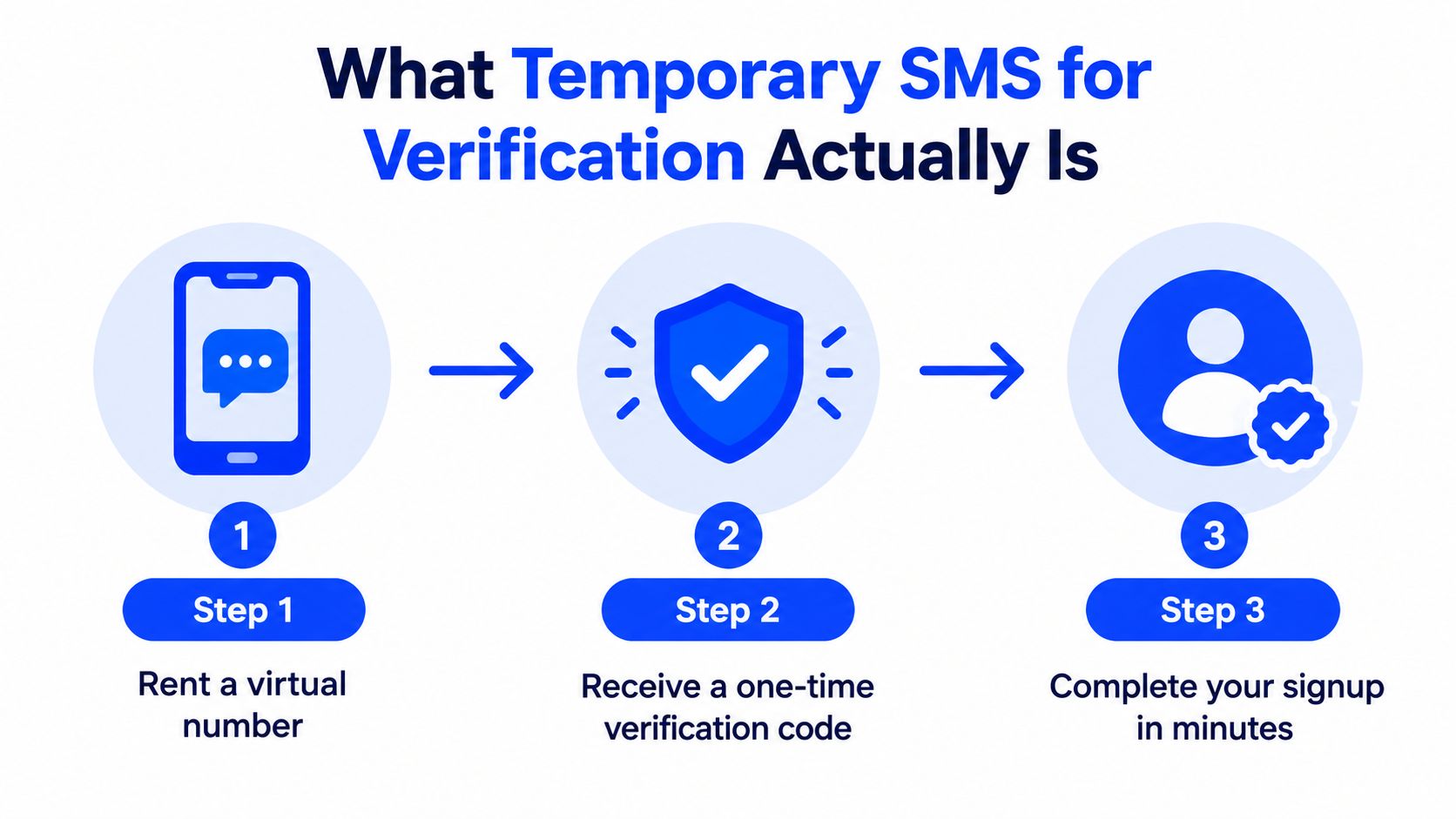
Temporary SMS for verification is access to a rented phone number, usually real or virtual, for receiving a code during a limited session. The usual flow is simple: select a supported service and country, obtain a number, enter it into the platform's registration form, wait for the message, and copy the code from the provider's dashboard.
The provider routes the incoming message through its gateway or mobile infrastructure. The user receives the code in an inbox, enters it before the session ends, and completes the verification attempt. The key trade-off is easy to miss: the user is purchasing access to a message, not acquiring a personal phone line.
A hypothetical example makes the boundary clear. Someone creates a secondary WhatsApp test account for a legitimate, short-lived experiment. The person selects a WhatsApp-supported number, enters it during registration, reads the incoming code, and finishes setup. Once the session ends, that number may no longer be available for a later WhatsApp login or security check.
The distinction between a virtual number and an owned line is explained in this guide to virtual phone numbers. That distinction should shape the decision from the beginning. If the account requires a future password reset, recurring two-factor authentication, or ownership evidence, a one-time inbox is a poor foundation.
Advantages and Hard Limits You Should Know
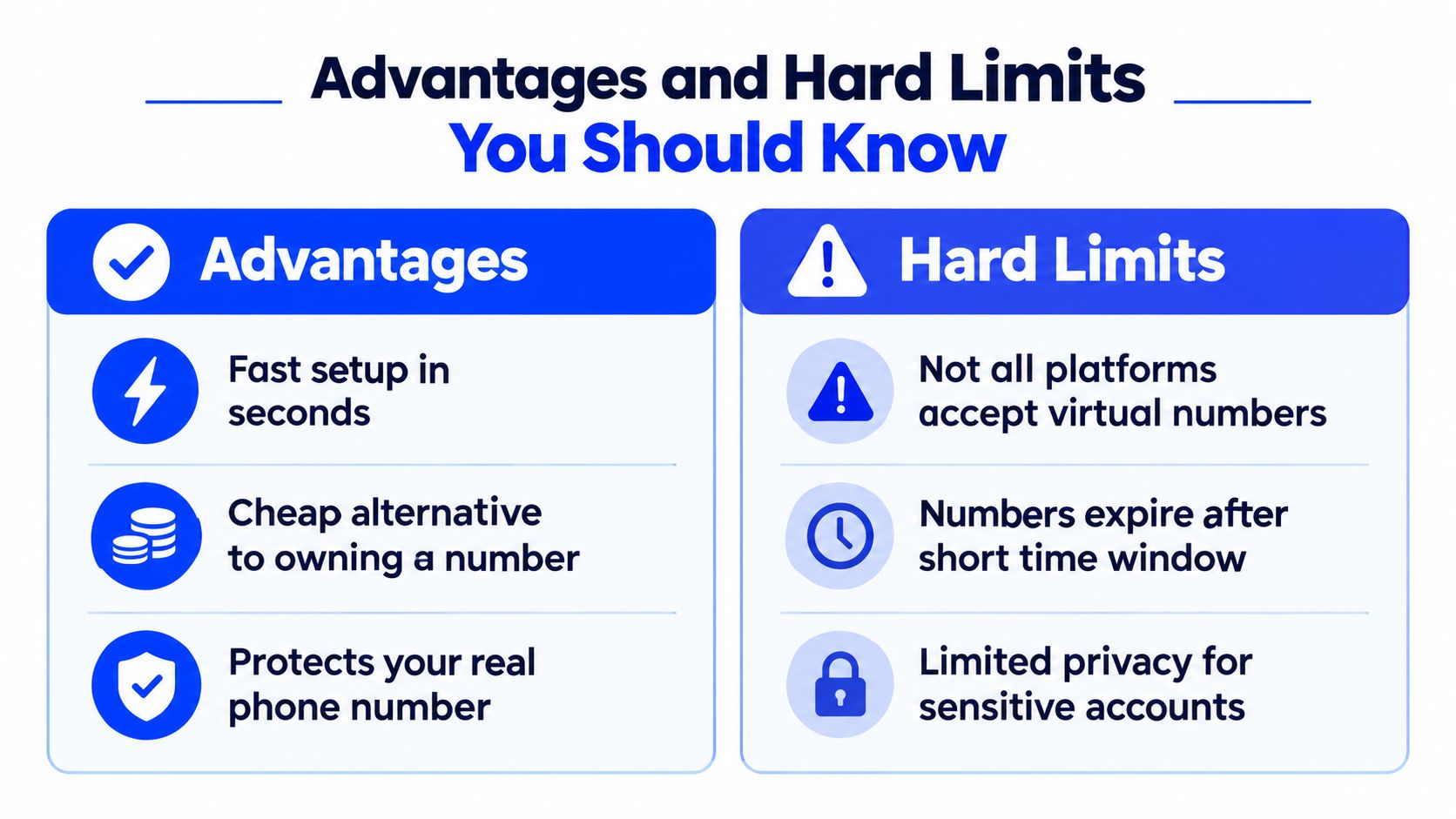
Temporary SMS has legitimate advantages. It can keep a personal number out of a registration database, support controlled testing across regions, and avoid the commitment of maintaining another SIM. It can also separate a short experiment from a person's primary phone identity.
The privacy benefit has limits, though. The number isn't necessarily private in the same way as a personal line, and the user shouldn't put sensitive information into an account that depends on an unfamiliar or temporary channel. A successful code also doesn't establish that the platform will accept the number again.
SMS itself carries security weaknesses. NIST's guidance on restricted authenticators treats SMS in relevant public telephone network and federated use cases as lower assurance because delivery to a number isn't strong proof of account ownership. SIM swaps, number porting, interception, and other attacks can undermine the channel.
Disposable numbers create another operational risk. One industry report describes traffic growing from thousands to millions of messages, more than 200,000 unique disposable numbers, and a typical number receiving about 1,000 OTP messages from roughly 200 senders in a day (GSM Association Services on disposable numbers). That environment explains why platforms screen number ranges, behavior, device signals, and network context.
Number recycling is a separate failure mode. A carrier or service may reassign a deactivated number, and a system that still trusts it can send a future code to someone else. That's why a temporary SMS session should never become the sole recovery method for an important account. It also shouldn't be used to evade a ban, create fraudulent identities, or bypass KYC and identity checks.
Common Use Cases and Where They Break
The following table gives a practical verdict before a user spends money. “Appropriate” means the task is limited and account loss is acceptable. “Risky” means the account may work initially but has a weak future. “Not supported” means the use case depends on ownership, stronger identity checks, or rules that may reject temporary numbers.
Use Case Suitability at a Glance
| Use Case | Fit | Why It Can Break |
|---|---|---|
| One-time signup for a low-stakes service | Appropriate | The platform may reject the number type or request another check later |
| Short-lived development or QA account | Appropriate | Test results can be distorted if the platform treats the number as disposable |
| Regional message-delivery testing | Appropriate | Country, carrier, and number-type requirements may not match |
| Secondary social account | Risky | Logout, device changes, or account review may trigger a new code |
| Marketing funnel or lead capture | Risky | The number may not support later contact, consent, or account recovery |
| Primary email recovery channel | Not supported | A different new number won't recover an account tied to its previous number |
| Financial or crypto account | Not supported | Identity checks, stronger controls, and account ownership requirements may apply |
| Messaging account that must be retained | Not supported | Future re-authentication may depend on the original number |
| Account creation intended to evade a ban | Not supported | It may violate platform rules and trigger further enforcement |
Platforms including Meta and Google may restrict virtual or disposable numbers, but acceptance depends on the current service rules and the particular offer. A provider can't promise that a number will bypass a restriction, ban, CAPTCHA, identity check, or unsupported number-type policy.
The most important boundary is account recovery. A different number can verify a new registration, but it doesn't become the old number attached to an existing account. Anyone who needs continuity should use the platform's official recovery method or a phone line they control.
A Suitability Checklist Before You Pay
A short checklist can prevent the common mistake of buying temporary access for a long-term account. Each “no” below is a stop signal, not an invitation to try a different provider.
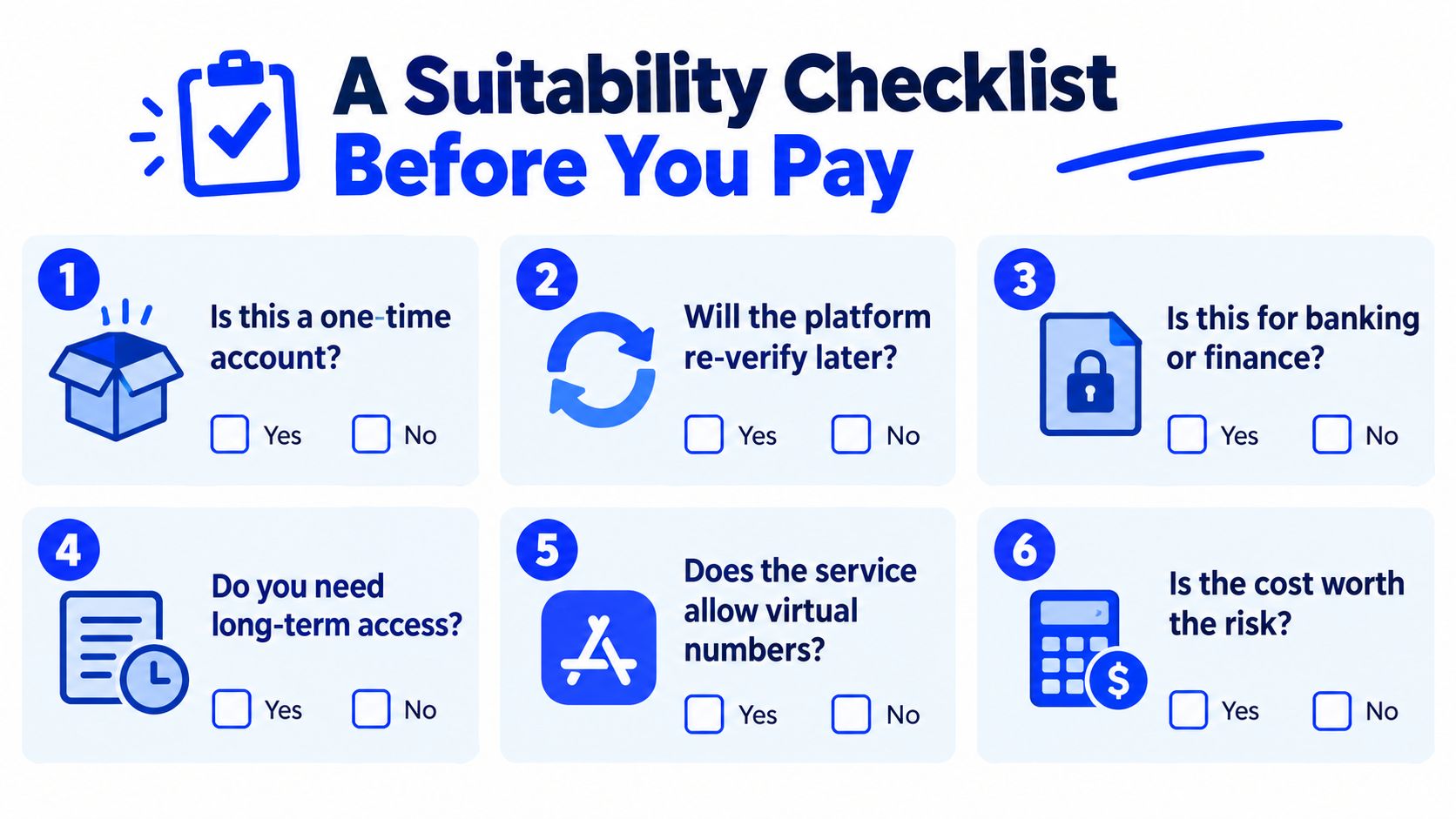
- Is the task one-time? If the account must remain available, use a lasting number or an official authentication method.
- Could the platform request another SMS? If yes, temporary access is unsuitable unless another recovery channel is already active.
- Is the account related to banking, finance, identity, or regulated activity? If yes, use the platform's accepted identity and recovery process.
- Does the platform permit the selected number type and country? Confirm the current official requirements before ordering.
- Can a free or official option solve the problem? Check trusted devices, recovery codes, passkeys, account support, or an owned number first.
- Would losing the account be acceptable? If no, stop and choose a method the account holder controls.
The AppLighter authentication checklist can help teams review authentication requirements before selecting a delivery channel. The same principle applies to individuals: verification is one event, while recovery is an ongoing responsibility.
A temporary number also shouldn't be treated as an account migration plan. If the platform offers a way to add a permanent recovery number, authenticator app, passkey, or backup code after signup, that should happen immediately, provided the platform permits it.
Choosing a Provider You Can Trust
A provider's landing page is only useful if its offer can be tested against the actual task. The first filter is delivery performance for the target country and platform, not a broad claim covering every market. A provider should make the selected number type, price, access period, and failed-delivery terms clear before payment.
Number policy matters just as much. Shared pools and previously used numbers may face more screening or carry messages intended for another person. For a low-stakes, one-time task, that may be an acceptable risk. It's unacceptable for an account that needs continued ownership.
| Criterion | What Strong Looks Like | What to Avoid |
|---|---|---|
| Offer details | Country, service, number type, price, and access period shown clearly | Vague “global” availability |
| Failed delivery | Refund or credit rules stated for the selected offer | Automatic-sounding promises with no terms |
| Number handling | Clear explanation of sharing and reuse practices | Claims that cannot be verified |
| Platform support | Current service and country availability | Assuming every platform accepts every number |
| Automation | Documented API or bulk workflow where needed | Manual-only process presented as scalable |
| Abuse controls | Clear acceptable-use rules and support path | Advice focused on bans or bypassing enforcement |
A provider can't guarantee third-party acceptance, and a good offer won't pretend otherwise. Buyers should compare two or three options using the same criteria rather than selecting the loudest success claim.
Teams assessing broader customer authentication should also review resources on auth for early-stage startups, especially when the underlying requirement is a durable authentication system rather than a one-time SMS receipt. For terminology around mobile and VoIP distinctions, this non-VoIP number guide is a useful adjacent reference.
The safest selection is the one that matches the narrow task. A low-cost temporary number may be reasonable for a disposable test account, but it shouldn't be presented as a substitute for a customer-owned line, passkey, authenticator, or recovery infrastructure.
Using LineVerifier for a Single Verification
Hypothetical task: a developer needs a second WhatsApp test account for a controlled experiment and accepts that the account may not be recoverable after the verification session.
The developer opens LineVerifier, selects the target service, chooses an available country and number type, and reviews the current offer and price. The user then pays for the selected number or adds funds according to the available checkout option, copies the temporary number, and enters it into the WhatsApp signup form.
The verification page displays the incoming message in the dashboard when the platform sends it. The user copies the OTP into WhatsApp and completes the registration attempt. Availability, access duration, number type, price, and any refund eligibility depend on the selected offer and the terms shown at the time of purchase.
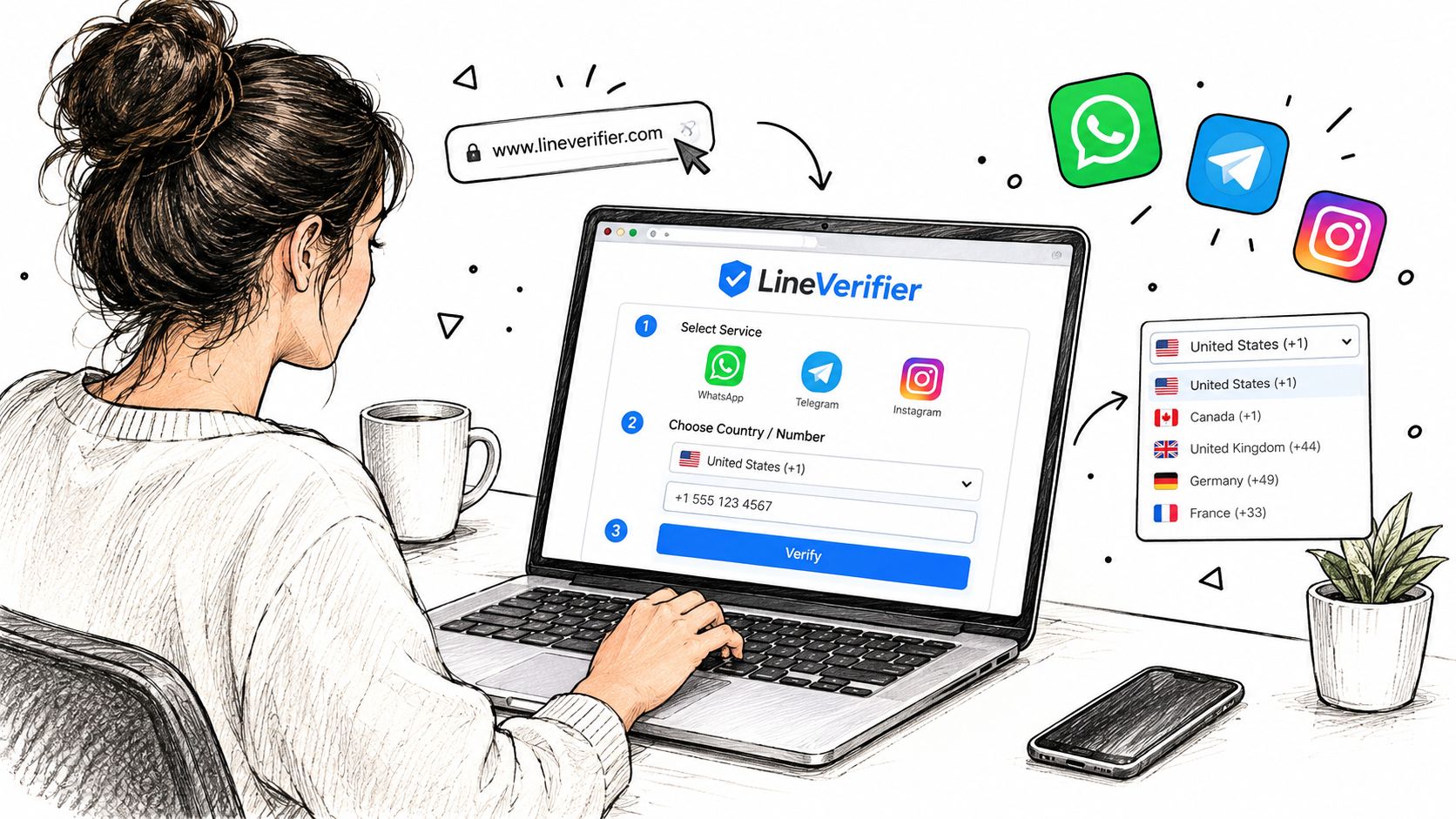
The operational limitation is more important than the click path. The purchased number is temporary, may expire after the offer's stated access period, and can't be assumed to support a later WhatsApp login, password reset, or re-verification. Refreshing or changing the session may affect availability for some pools, so the user should follow the dashboard's current instructions rather than assume the number remains reserved indefinitely.
LineVerifier also offers an API for programmatic ordering and SMS receipt, which can suit authorized development or testing workflows. Bulk or API use doesn't change the ownership limitation, and it doesn't bypass a platform's restrictions.
Troubleshooting and Recovery Questions
If a code doesn't arrive, first confirm the country code and number format, then check that the selected service and number type match the platform's requirements. The platform may block virtual, disposable, or otherwise unsupported ranges. Waiting through the offer's stated access period can be reasonable, but repeated purchases won't solve a platform-level restriction.
A different country pool may help only when the platform legitimately supports that region and the user is authorized to create the account. It won't bypass a ban, identity check, CAPTCHA, or unsupported number policy. Voice verification is also separate from SMS, so SMS access shouldn't be treated as evidence that calls will work.
For troubleshooting the message itself, see this guide on how to receive an SMS verification code. For recovery, the answer is firmer: a temporary number generally can't receive a later password-reset SMS after the session ends, and it can't restore an account tied to an earlier number.
Apple distinguishes ordinary verification-code access from account recovery. If trusted devices or a trusted number are temporarily unavailable, Apple directs users toward regaining access or starting its official recovery process (Apple account recovery guidance). Google likewise distinguishes a short-lived recovery-contact code, where the provided number expires after 15 minutes, from a recovery phone number intended for future access (Google's recovery-contact instructions). Google's separate guidance recommends using the user's own text-message-enabled mobile phone for recovery (Google recovery phone help).
The correct recovery path is the platform's in-app recovery flow, official support, trusted device, recovery code, passkey, or identity-based process. Buying a new number is not account recovery.
A temporary SMS session is appropriate only when the reader needs a supported, limited verification event and accepts the loss of future access. For that narrow use case, LineVerifier provides access to selected temporary numbers and SMS codes through its dashboard, with availability and terms shown for each offer. Readers should use it only for legitimate tasks where the third-party platform's requirements fit and a permanent recovery channel isn't required.