.png&w=384&q=75)
Private Number for WhatsApp: A Privacy Decision Guide
Who can see the number behind a WhatsApp profile after the verification code has done its job? That question exposes the flaw in most advice about a private number for WhatsApp. A separate number can protect a personal SIM from clients, dates, customers, or extended family, but it doesn't automatically make the WhatsApp identity private, durable, or recoverable.
The right decision depends on three moments: who sees the number during everyday use, how long the account must remain available, and what happens when WhatsApp asks for verification again. WhatsApp is phone-number based, so privacy settings and number choice solve different problems.
What “Private” Actually Means on WhatsApp
A private number isn't a single WhatsApp setting. It describes a set of visibility decisions that change depending on the audience and the moment.
First, consider profile visibility. A contact may see information such as a profile photo, About text, or online status according to the account's privacy settings. A separate number can stop that person from learning a personal mobile number, but it doesn't necessarily stop them from seeing the identity attached to the WhatsApp account.
Groups create a different exposure point. A group member may be able to see the number associated with participants, including people who were previously strangers. A quoted or forwarded message can also continue circulating after the original conversation ends. Privacy settings can limit some profile information, but they can't turn a WhatsApp number into an anonymous identifier in every context.
The third question is external discovery. A number may be saved by someone else, shared in a group, or used by a person who already knows it. A separate line reduces exposure of the primary number, yet it doesn't remove the number from WhatsApp's identity and contact infrastructure.
Practical rule: Decide who the number must stay private from, rather than asking whether the number is simply private.
During recovery, privacy becomes an access question. WhatsApp sends a registration code by SMS or may offer a voice call, and the person who controls the number must be able to receive that traffic. The difference between hiding a personal number and controlling a recoverable account is explained in this guide to hiding a phone number in WhatsApp.
How WhatsApp Ties Identity to a Phone Number
Could a second number keep your WhatsApp identity private by itself? No. WhatsApp uses the phone number as the account's central identifier, so privacy depends on who can see that number, when they can see it, and whether you can still recover the account later.
After you enter a number, WhatsApp confirms ownership with a 6-digit registration code sent by SMS. If SMS fails, it may offer a voice call, according to its official registration guidance. The same verification process can return when you register the account on another device or WhatsApp needs to confirm ownership. A second number must therefore remain reachable for the account's full lifespan, not just during signup.
Two-step verification adds account protection. WhatsApp introduced it worldwide in February 2017 for more than 1 billion users, requiring a 6-digit passcode when someone re-registers the number, reported by The Verge. You can also add a recovery email, reducing dependence on SMS, as explained on WhatsApp's two-step verification help page.
Keep these three responsibilities separate:
- Possessing the number means receiving registration traffic.
- Controlling the account means protecting the two-step PIN, maintaining recovery access, and keeping the line active.
- Protecting the identity means limiting where contacts, group members, and other audiences can see the number or profile details.
WhatsApp states that registration is phone-number based and may use carrier data for verification and fraud prevention. Messages and calls remain end-to-end encrypted, but number verification can involve carrier sharing of account and device data, according to WhatsApp's verification documentation.
A private number separates identities. It does not remove WhatsApp's reliance on phone-number infrastructure.
Matching Number Types to Privacy Scenarios
Number choice should follow the account's expected lifespan and audience. A number that works for a one-off signup may be a poor choice for client conversations, family groups, or an account holding important chat history.
| Number Type | Signup & Verification | Daily Visibility | Recovery Reliability |
|---|---|---|---|
| Personal SIM | Usually practical if it receives SMS or calls | Exposes the primary number wherever WhatsApp displays it | Strong while the owner keeps the line |
| Dedicated second SIM | Practical when it remains active and reachable | Separates personal and professional or social audiences | Stronger than a disposable line because the owner controls continued access |
| Prepaid disposable SIM | May support initial verification, subject to carrier and platform checks | The number remains visible to WhatsApp contacts and groups | Weak if the SIM expires, is lost, or is reassigned |
| VoIP number | May fail if WhatsApp rejects the number range or verification route | Separates the primary number only if the account remains usable | Variable, depending on continued control and re-verification support |
| App-based virtual number | Can be suitable for a limited verification task, but availability isn't assured | The WhatsApp identity still uses that number after signup | Often weak when access depends on a short rental or provider account |
| Premium private line service | Depends on the selected offer and whether WhatsApp accepts the number type | Can separate the personal number from the WhatsApp audience | Depends on the offer's access terms, continued availability, and recovery plan |
For client calls or an ongoing side business, a dedicated second SIM or another line the owner can keep reachable is the sensible default. For a short-term project with no valuable history, a temporary option may fit, but the account should be treated as disposable.
Dating and family separation require a different test. The question isn't only whether a contact sees a personal number. It also asks whether that contact can add the account to groups, connect the profile to other information, or reach the number outside WhatsApp.
Voice access matters too. WhatsApp supports SMS and phone-call verification, but receiving SMS doesn't prove that a number supports voice calls or functions as a permanent phone line. The WhatsApp travel verification guidance confirms that users must be able to verify by SMS or phone call, with roaming or voicemail potentially relevant to the situation.
The Temporary Number Illusion
A temporary number protects privacy only during the narrow moment when it keeps a primary number out of the signup form. Once WhatsApp activates the account, the temporary number becomes the account's visible anchor.
The exposure can expand through ordinary use. Contacts who save the number may find the profile, group members may see it in shared spaces, and quoted replies can preserve the identity in conversations that outlive the original exchange. Privacy settings can reduce profile exposure, but they don't change the number attached to the account.
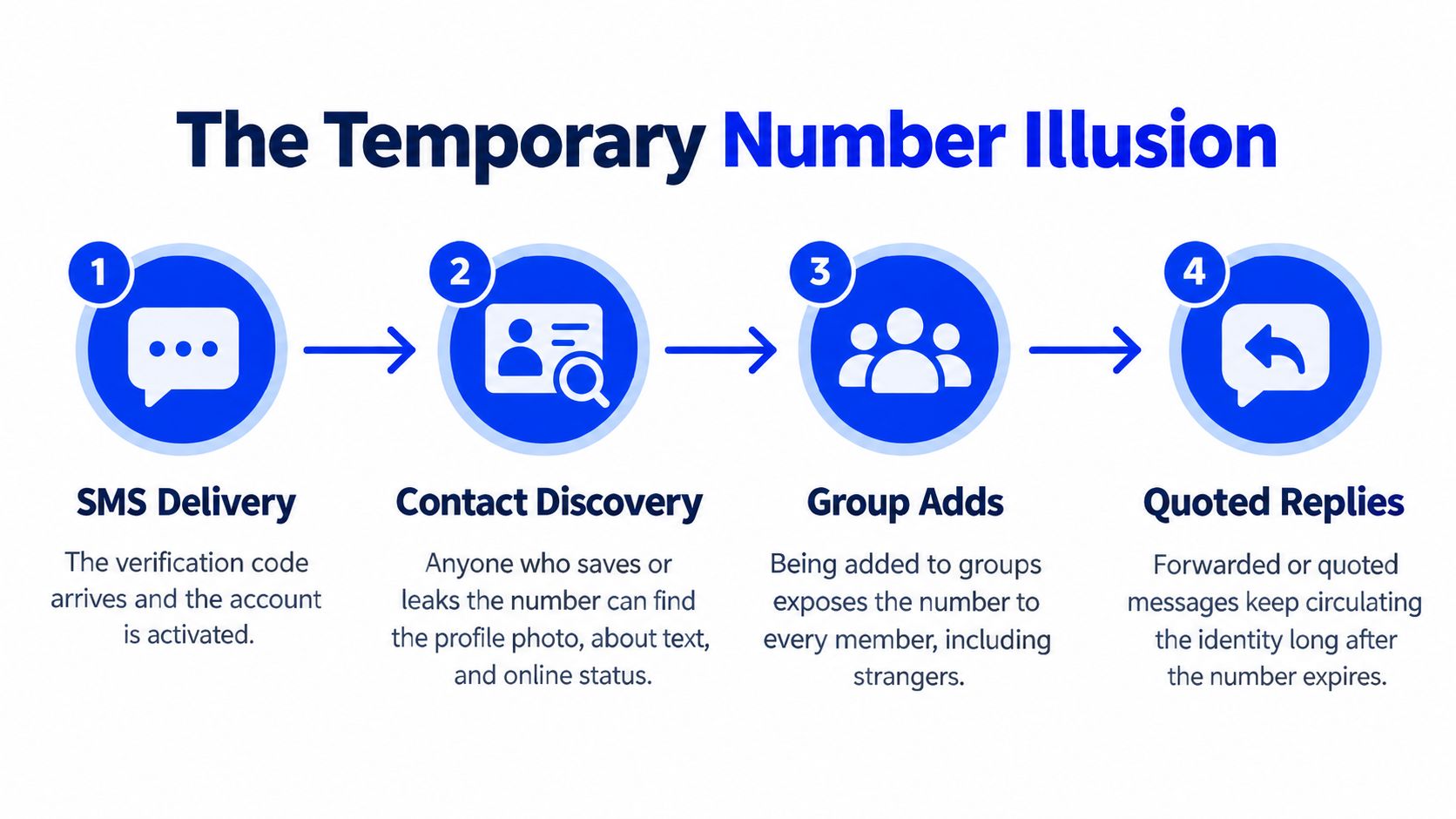
The bigger weakness appears later. WhatsApp actively blocks or rejects many virtual number ranges, and a number can be recycled or controlled by someone else. That creates a risk during future re-verification, especially when the original user no longer controls the line, as discussed in this analysis of temporary numbers as a privacy and security risk.
A temporary number can make sense for a short-lived account with no important conversations and no expectation of recovery. It isn't a sound privacy foundation for an identity that must remain available for clients, customers, family, or long-term groups. The temporary number guide for WhatsApp covers the narrower signup question. The lifecycle decision is more demanding.
Choosing and Verifying a Private Number Setup
Start with the privacy objective, not the number label. Someone separating clients from family needs a durable second line. Someone testing a short-term workflow may only need reliable SMS access for initial registration. Those are different requirements.
Before selecting a number, answer four practical questions:
- Can it receive the required channel? WhatsApp may send the code by SMS or offer a voice call. If SMS is the only supported route, voice capability won't solve a failed SMS delivery.
- Will the number stay under the user's control? Ask whether the provider can reassign it after cancellation, whether continued access is required, and whether the offer describes a line or only a verification session.
- What number type is being supplied? WhatsApp may restrict virtual or VoIP ranges. No provider can promise that a third-party platform will accept a particular number.
- What happens after signup? Check whether the number can receive another code, whether it remains reachable during travel, and whether the account has a recovery email and protected two-step PIN.
A successful first verification proves only that the code arrived on that occasion. It doesn't prove long-term account durability, voice support, freedom from recycling, or acceptance during a later registration attempt.
The daily privacy check deserves equal attention. Review who can see the profile photo, About information, and online status. Consider which groups the account will join and whether group members are trusted. Read receipts and contact behavior affect what others learn about activity, even when the primary number remains hidden.
LineVerifier offers paid SMS verification for selected services and countries, with availability, number type, price, access duration, and refund eligibility shown for the selected offer. It can receive an SMS verification code, but a purchased number doesn't guarantee WhatsApp acceptance or continued account access, and SMS access doesn't establish a permanent phone line. Anyone using such an offer needs recovery methods they control.
Recovery Scenarios That Bite Later
Have you decided how the account will be recovered before choosing a number? A number selected only for signup can become a liability once it expires, is recycled, or stops receiving codes. Account privacy depends on who can reach the number during registration, daily use, and recovery.
WhatsApp states that changing a phone number or SIM requires the Change Number feature to transfer the account. If the old SIM or number is lost before that transfer, access to the existing account is permanently lost, and the new SIM requires a new account, according to WhatsApp's official change-number guidance.
A replacement number does not restore the previous account. It creates a separate registration unless the existing account is deliberately moved through WhatsApp's supported process while the necessary details and verification remain available. The process requires both old and new numbers in full international format, followed by verification on the new number. WhatsApp also says an accidental number change cannot be reverted, as stated in its change-number instructions.
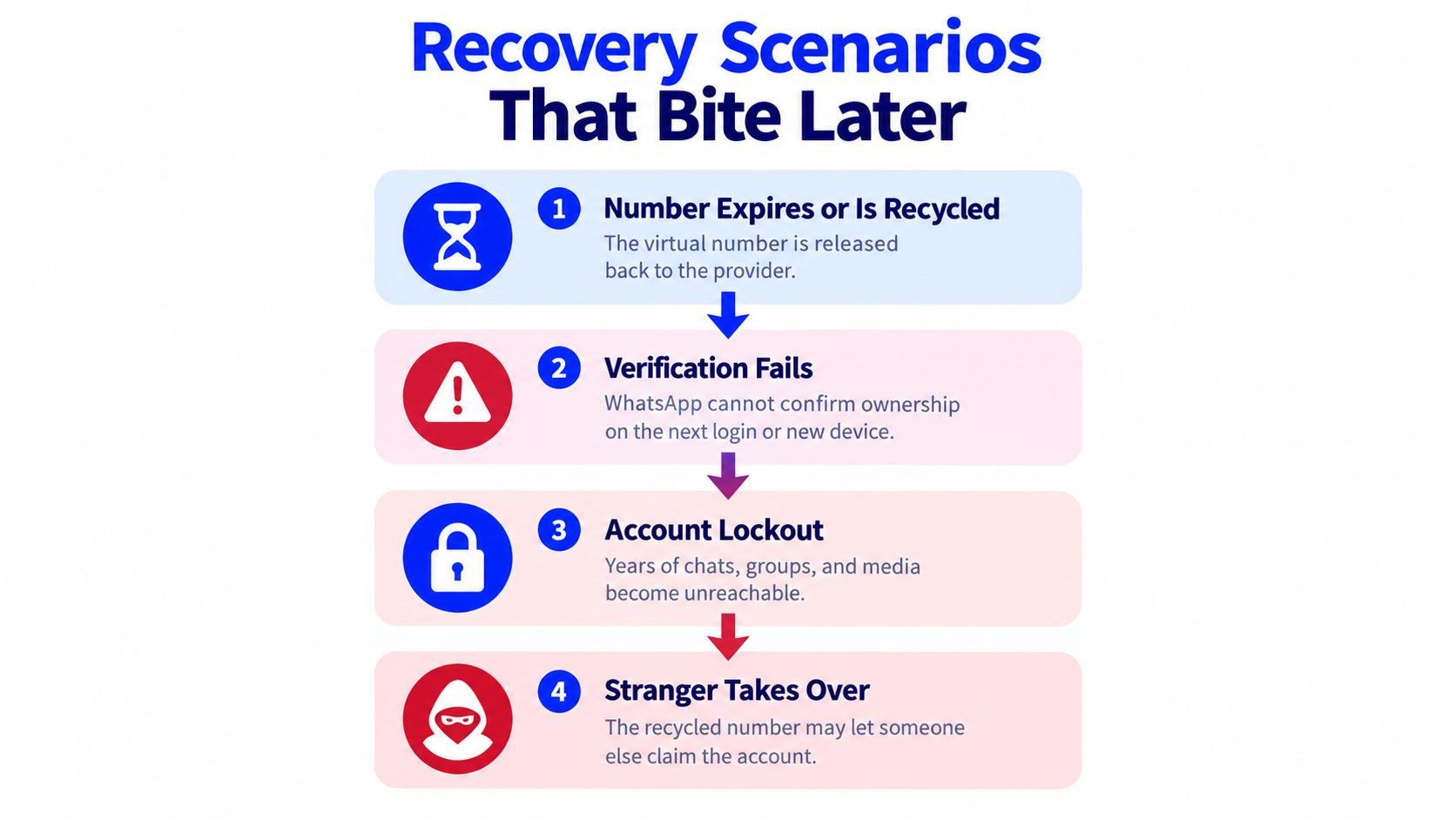
Two-step verification adds another recovery gate. A future re-registration requires the PIN as well as the registration code. If the PIN is forgotten, WhatsApp may require a 7-day wait before reset, as described in its security guidance. Number access and account access therefore remain connected, but they are not the same control.
Set the recovery plan before the number expires. Store the PIN securely, add a recovery email where available, and keep the registered line reachable for as long as the account matters. A non-VoIP number option may suit accounts where platform acceptance and continued control matter more than a short-lived signup. A temporary number is a signup method, not a recovery strategy.
Three Readers, Three Real Outcomes
Identical-looking setups can produce different results because the audience, lifespan, and recovery plan aren't identical.
| Reader | Number Type | Outcome After 6 Months |
|---|---|---|
| Maya, a freelance designer | Paid VoIP line with protected two-step PIN storage | Client conversations stay separate while the line remains reachable and the recovery controls remain available |
| Tariq, a sneaker reseller | Cheap online SMS verification number | A later re-verification request becomes a problem when the original number is no longer available, forcing a disruptive account reset |
| Lena, a privacy-conscious parent | Secondary family-plan line for a child's tablet | Group invitations expose the secondary line to extended relatives, despite keeping the primary personal number separate |
Maya's arrangement fits an ongoing separation goal because she treats the number as an account asset, not a one-time code receiver. Her privacy benefit comes from controlling the audience and preserving recovery access, not from the word “private” in the product description.
Tariq's choice fits a short verification task, not a customer-facing account that needs continuity. Once the number becomes unreachable, a new number doesn't recreate the old identity or restore access to its history.
Lena solves the primary-number problem but not the group-visibility problem. Her relatives don't need access to the personal SIM to learn the secondary WhatsApp number. The cross-cutting lesson is blunt: number choice, durability, and audience exposure work together. A technically successful signup can still create the wrong privacy outcome.
Decisions Worth Making Before You Start
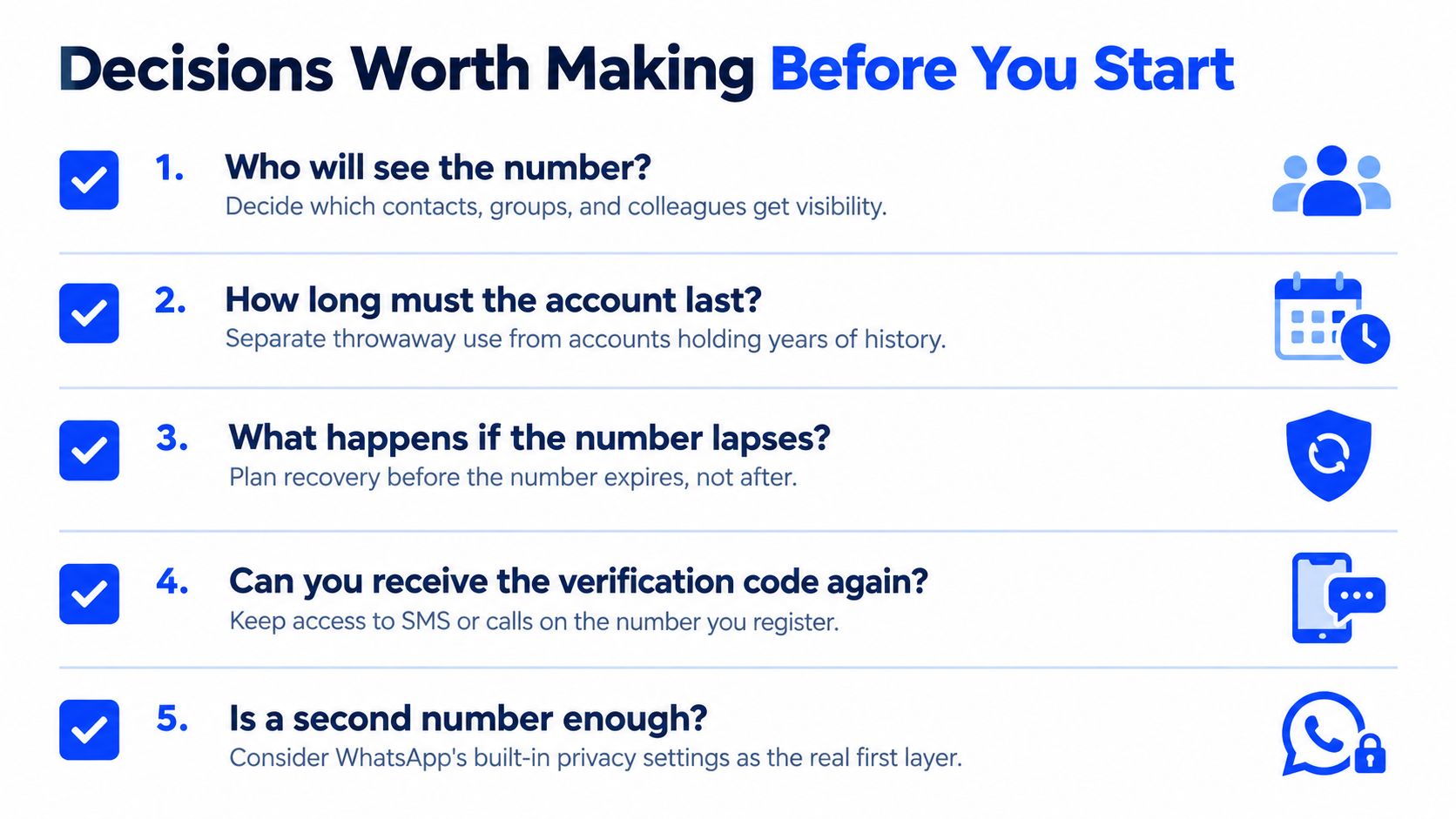
A private number is worth the effort when it separates a real audience and has a recovery path that can survive the account's expected lifespan. Before registration, work through these questions in order.
- Who will see the number? Separate clients, dates, customers, family members, and group participants. The answer determines whether a second number solves the actual exposure problem.
- How long must the account last? An account for a brief project has a different risk profile from one containing years of chats, groups, and media.
- What happens if the number lapses? Decide how the account will be moved before the line expires or becomes unreachable. Don't wait for the first failed verification.
- Can the number receive verification again? Confirm whether SMS or calls can reach the line when WhatsApp asks for ownership proof later.
- Is a second number enough? Review WhatsApp's privacy settings, group behavior, profile visibility, and contact discovery. Number separation is only one layer.
WhatsApp is also beginning to roll out usernames, which can reduce number exposure to new contacts after signup, while the phone number remains required to create the account, as reported by Al Jazeera's coverage of WhatsApp usernames. That change improves contact-facing privacy in some situations, but it doesn't remove the registration and recovery dependency.
A dedicated, controllable line is the strongest fit for ongoing relationships that must stay separate from a personal number. A disposable number is a poor choice when customers, family, or important records depend on the account. If most answers point toward short-term use and weak recovery, disciplined WhatsApp privacy settings on a personal account may be safer than chasing anonymity through a number that can disappear.
LineVerifier provides paid SMS verification for supported services and countries, with the current offer, number type, access terms, price, and any refund eligibility shown before use. For a short-term WhatsApp setup where the selected offer fits the verification need, visit LineVerifier, then keep a recovery method under the account owner's control.