.png&w=384&q=75)
Cheap Telephone Numbers: Risks and Real Costs
A number that costs very little can still become expensive the moment an account asks for a recovery code, rejects the number type, or sends messages intended for a previous owner. The right choice depends less on the sticker price than on the job the number must perform: a one-time SMS session, a second line for occasional messages, or a phone number that must remain under the buyer's control for months or years.
The practical answer is straightforward. Cheap telephone numbers can work for limited verification tasks, but they're a poor foundation for long-term account recovery unless the offer clearly provides durable access and the target platform accepts that number type. A new number also won't restore an existing account tied to its previous number.
The Hidden Reality of Budget Phone Lines
A user creates a new profile, receives the verification code, and assumes the problem is solved. Later, the platform requests another security check. The number has expired, been reassigned, or become unavailable through the original service. The user still knows the password, but the account now depends on a phone line they never controlled.
That scenario captures the central risk of cheap telephone numbers. A low price often reflects limited access, not ownership of a permanent personal line. The offer may provide a temporary SMS routing session, a virtual VoIP line, or a mobile number with a defined access period. Those are different products, even when each appears in a checkout flow as “a phone number.”
What the price usually represents
A temporary verification number is designed to receive an SMS for a selected service. It may not support voice calls, incoming messages from other services, future recovery attempts, or continued access after the selected offer ends. A virtual VoIP line can be more persistent, but platforms may classify it differently from a mobile number. A traditional mobile line generally has stronger continuity, though it costs more because the provider maintains a subscriber relationship and mobile network access.
The phrase “permanent,” “guaranteed,” or “works everywhere” deserves caution. Platform acceptance changes, number ranges acquire reputational history, and providers can change availability or renewal terms. No number type automatically bypasses a ban, identity check, CAPTCHA, or unsupported-number rule.
Practical rule: Buy the shortest-lived number only when the account itself has a short-lived purpose. A critical account needs a number and recovery method that remain under the account owner's control.
Platforms may flag a number because its range, carrier type, or prior usage doesn't match their risk requirements. A code arriving successfully proves that the message reached that line. It doesn't prove that the platform will accept the number later, or that the current user will retain access to it. Readers comparing the risks of disposable and persistent lines can review why fake phone numbers create account and privacy problems before choosing an offer.
Why Number Scarcity Drives Recycling
Telephone numbers are a managed public resource, not an unlimited pool of disposable identifiers. The North American Numbering Plan was created in 1947, establishing a nationwide 10-digit structure across much of North America and the Caribbean, with 86 original service territories. Its design assigns 10,000 numbers to each prefix, while current numbering rules provide 792 usable prefixes per area code, allowing one area code to support about 7.92 million numbers when those allocations are available. The numbering structure is described in Bandwidth's explanation of the North American Numbering Plan.
Dense markets consume available prefixes as mobile adoption, business lines, and new allocations increase demand. Once a block becomes difficult to allocate efficiently, regulators and carriers use relief measures, conservation programs, and new area codes. Thousands-block pooling can reduce NXX consumption by 50% to 70% in areas where it's mandatory, according to the NANP expansion draft, which helps explain why forecasts can move substantially when conservation improves capacity planning. A Canadian regulatory projection in 2000 placed possible NANP exhaustion in the 2025 to 2030 timeframe, while a later draft cited a baseline projection of 2060 and a sensitivity case as early as 2052, illustrating how strongly planning assumptions affect the outlook. These projections appear in the IETF draft on possible NANP expansion.
How reassignment breaks identity assumptions
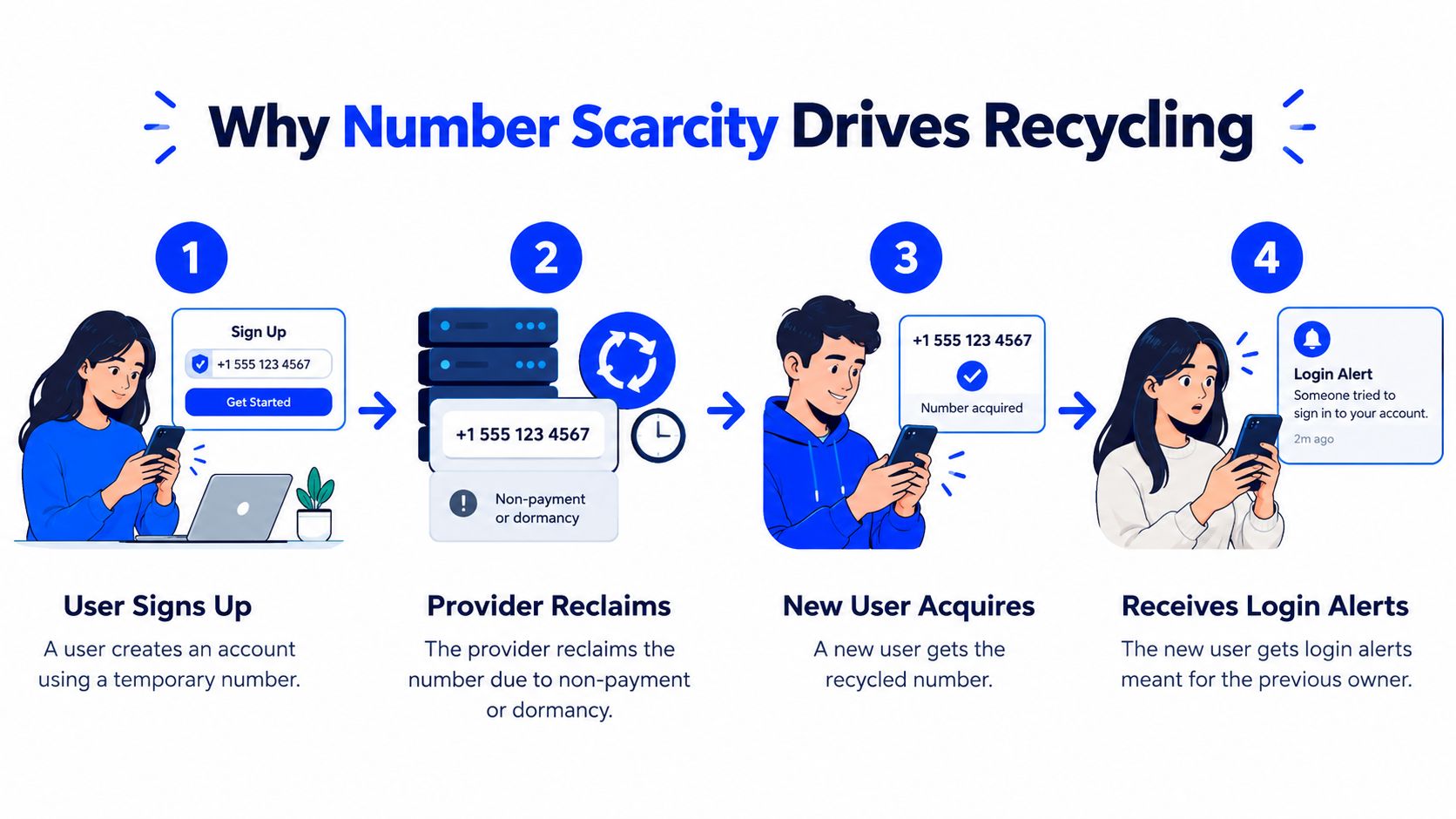
When a subscriber disconnects a number, the carrier can return it to a pool after a waiting period and later assign it to someone else. That process is called phone number recycling. A new subscriber can then receive messages intended for the previous user, while the platform still has the number recorded as a recovery or verification factor.
SMS verification confirms message routing. It doesn't confirm continuing ownership of the account, the person who originally registered the number, or the identity of the current recipient. That's why a strong account-recovery flow should verify the current SIM or subscriber context when possible, or require additional factors before allowing a password reset, sensitive account change, or step-up authentication.
A number that worked yesterday may therefore become unsuitable without any technical fault in the SMS system. The line may have just changed hands, while the platform's security record has not caught up. For long-term accounts, relying on a recycled or temporary number creates a dependency that becomes visible only at the worst possible moment.
Comparing the True Cost of Number Types
The most useful comparison starts with the intended function. A temporary verification session, a second SMS line, and a lasting voice number should not be evaluated with the same cost model.
A local VoIP DID commonly costs around $1 to $2 per month, while traditional PSTN carriers may charge roughly $4 to $8 per month for the same number. Toll-free services typically add inbound fees around $0.01 to $0.04 per minute, and international DIDs can cost about $5 to $25 per month, depending on country and regulatory availability. These figures and the main pricing drivers are outlined in this DID number cost estimator.
| Number Type | Typical Cost Structure | Best Use Case | Recovery Viability |
|---|---|---|---|
| Temporary verification session | One-time fee or limited access tied to a selected SMS use | A single, low-consequence account setup | Low. It may not remain available for later recovery |
| Second SMS number | Per-use charge or recurring access, depending on the offer | Separating occasional registrations from a primary number | Low to moderate. Depends on renewal, reassignment controls, and platform acceptance |
| Local VoIP DID | Commonly around $1 to $2 per month, with renewal charges | A lasting business or personal voice line where VoIP is accepted | Moderate. Better continuity than a session, but not equivalent to a mobile subscriber line |
| Traditional PSTN or mobile line | Commonly around $4 to $8 per month for a traditional PSTN number, plus plan conditions | Long-term calling, SMS, and account recovery | Higher, provided the subscriber maintains the line and the platform accepts it |
| International DID | About $5 to $25 per month depending on country and availability | Local presence in a supported international market | Variable. Regulation, carrier type, and platform rules matter |
Calculate the cost of failure
A low upfront charge may become uneconomical if the buyer later has to rebuild account access, contact support, replace a locked profile, or abandon a number-dependent workflow. That doesn't mean every temporary offer is unsuitable. It means the buyer should match the access period to the account's expected life.
An eSIM comparison can also mislead if it treats data connectivity as equivalent to a phone line. A data-only eSIM may not provide a number or SMS capability, so readers comparing mobile alternatives should review how much eSIM plans cost and confirm whether the plan includes calls and texts.
For a lasting voice line, renewal conditions matter more than the initial month. For a second SMS number, the buyer should ask whether the number stays assigned, whether incoming messages remain available, and what happens after cancellation. For a limited verification session, the relevant question is narrower: does the selected platform, country, and number type fit the immediate task?
Readers who need to understand why mobile and VoIP classifications differ can consult this guide to a non-VoIP phone number, then verify the target platform's current requirements before paying.
Evaluating Providers and Platform Rules
A provider's checkout page rarely answers every question that matters after verification. A careful buyer should treat the purchase as a compatibility decision, not just a price comparison.
A provider diagnostic checklist
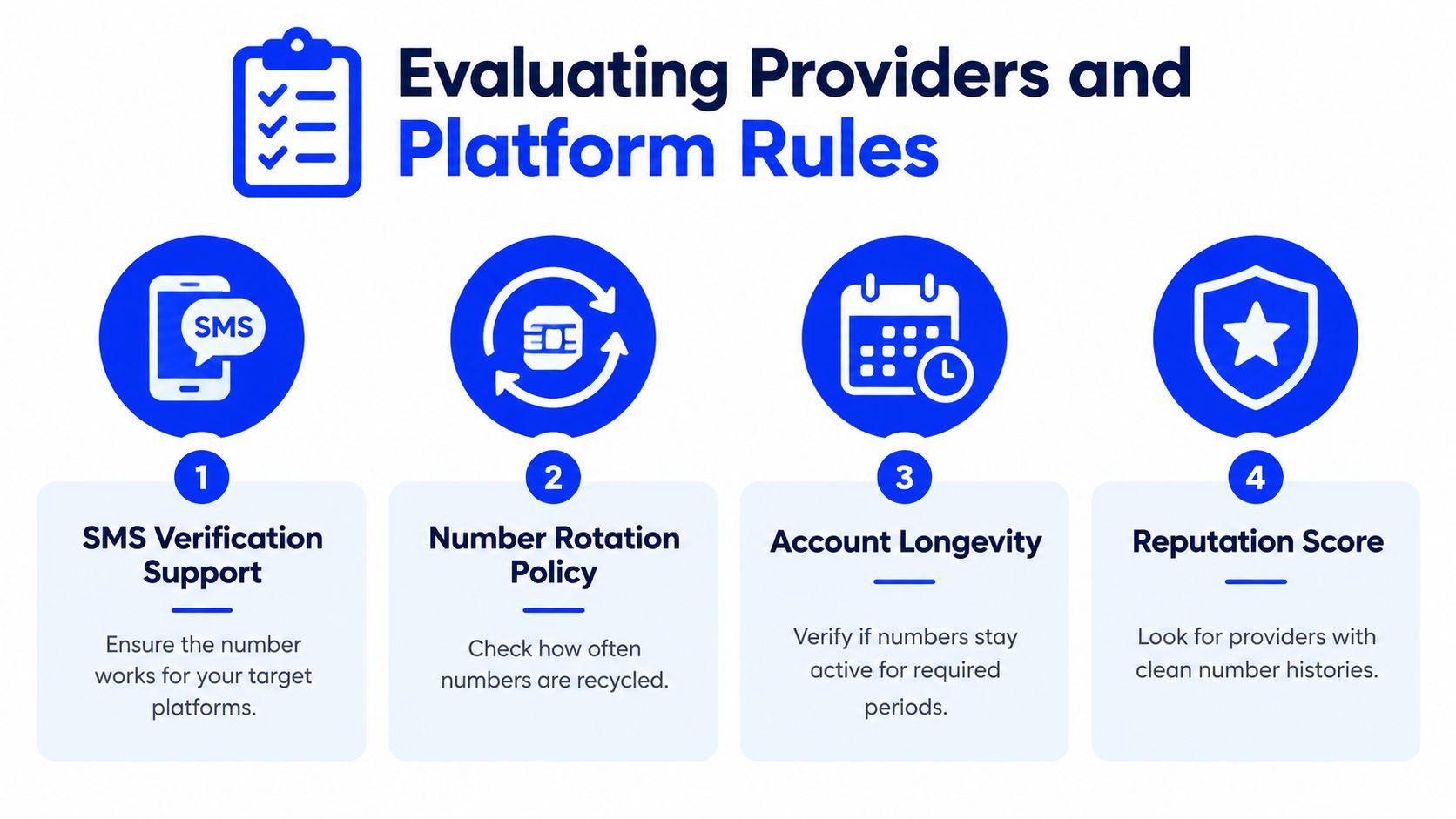
Identify the exact function. Decide whether the number needs to receive one SMS, support repeated messages, handle voice calls, or remain available for recovery. A temporary SMS product shouldn't be presented as a permanent line.
Check the number type. Look for mobile, VoIP, landline, DID, or another explicit classification. If the provider doesn't disclose it, the buyer can't reliably compare the offer with the target platform's rules.
Read current availability and renewal terms. Confirm the country, supported service, access duration, renewal conditions, refund eligibility, and any restrictions shown for the selected offer. Don't infer permanent access from a number being visible in a dashboard.
Review platform documentation. Google's account guidance says a recovery phone should be a mobile phone that receives text messages and belongs only to the account holder. It also warns against using a Google Voice number as a recovery phone because losing access to that number can lock the user out. The relevant requirements appear in Google's recovery phone guidance.
Separate new registration from recovery. A number that works while creating a new account doesn't automatically work for recovering an existing one. Recovery systems may use different risk checks, historical signals, and rate limits.
Stop repeated attempts when the platform rate-limits recovery. Google says it limits password-recovery attempts through email, SMS, and the Account Recovery form. Its help content also indicates that a new phone number may need to remain established before it can be used for sensitive actions. Repeated retries won't turn an incompatible number into a trusted recovery factor.
What reliability evidence can and can't show
A provider may advertise country coverage or a large inventory. Those details don't establish acceptance by a particular platform. Likewise, an unanswered quality question isn't evidence of poor service, but it is a reason to avoid making assumptions.
For teams, the data requirement may be broader than SMS. A CRM workflow needs a number that can be stored, normalized, assigned to an authorized account, and retained according to operational policy. A resource on CRM-ready phone number data can help teams think about data quality separately from one-time verification access.
Security boundary: No budget provider can guarantee that a third-party platform will accept a number, remove a restriction, skip an identity check, or restore an account.
A practical test uses a low-consequence account that the owner is authorized to manage, follows the platform's published rules, and records the offer's terms before purchase. It shouldn't involve evading a ban, creating deceptive identities, or repeatedly submitting numbers after the service has rejected them.
Strategic Alternatives for Secure Verification
The safest alternative to a cheap temporary number is often an official recovery method that the account owner already controls. Recovery email, an authentication app, backup codes, a passkey, or a hardware security key can reduce dependence on a phone number. SMS may remain useful, but it shouldn't be the only route into an important account.

Match the alternative to the account
A privacy-conscious user setting up a short-lived service may choose a temporary SMS session, provided the account doesn't hold important data and the platform accepts the selected number type. The user should avoid treating that number as a future recovery asset.
A business owner managing a customer-facing account should use a lasting mobile or business line, document who controls it, and keep a second authentication factor available. A team should also define what happens when an employee leaves, a carrier changes the number, or billing lapses.
A developer testing an SMS workflow needs authorized test accounts and a clear distinction between testing message delivery and proving production identity. A successful test message doesn't demonstrate that the same number will be accepted for every user, region, or security state.
Recovery requires continuity
A different new number cannot recover an existing account that's tied to its previous number. The account holder needs to use the platform's official recovery process, prove control through the available factors, or contact the platform where support is offered. Trying unrelated numbers can consume limited recovery attempts and make the situation harder to diagnose.
Google also distinguishes a recovery phone from a sign-in factor. Its account help explains that a recovery phone can receive a text when the user is locked out, while two-step verification can use text codes during sign-in. Google advises users to delete received codes and never share them with anyone, as described in Google's account verification guidance.
The strategic choice is therefore simple:
- Temporary privacy: Use a limited number only for a low-consequence task and don't attach critical recovery obligations to it.
- Long-term access: Use a subscriber line or another factor that the account owner can maintain directly.
- Account recovery: Start with official recovery options, not a newly purchased number.
- Team operations: Assign ownership, preserve billing access, and document the recovery process.
The following video offers additional context for readers comparing authentication methods and account protection practices.
Readers considering a limited SMS use case can also review this guide to a temporary phone number for verification, then compare its stated offer terms with the account's actual security needs.
Answers to Common Verification Questions
Can one number be reused across platforms?
Possibly, but reuse increases the chance that a platform has already recorded the number, rejected its type, or associated it with previous activity. Google's support guidance indicates that a number may be refused after it has been used too many times for verification or identified as recycled. Deleting accounts that used the same number doesn't necessarily reset the platform's internal usage count, so switching between repeated attempts may not solve the rejection. The relevant warning appears in Google's support discussion about numbers used too many times.
Does receiving an SMS mean the number supports calls?
No. SMS delivery only confirms that a message reached the available routing destination. It doesn't establish voice capability, long-term assignment, or future recovery access.
Can a new number bypass a restriction?
No number should be treated as a bypass for a platform ban, CAPTCHA, identity check, or unsupported number-type rule. A new number also doesn't change the ownership history of an existing account.
What should happen when a code doesn't arrive?
The user should check that the selected country, service, number type, and account details match the platform's requirements. If the platform rate-limits attempts, repeated requests should stop. For an existing account, the official recovery route is safer than buying a succession of replacements.
The cheapest number is the one that fits the task without creating a recovery dependency. Readers can review the current offer, country availability, access conditions, and applicable terms on LineVerifier before using a paid temporary SMS option. The service is intended for receiving verification codes, not as a guarantee of permanent ownership, voice access, or acceptance by every third-party platform.