.png&w=384&q=75)
Amazon OTP Text Explained and What to Do Next
An Amazon OTP text is a one-time SMS code Amazon sends as part of two-step verification to confirm it's really the account owner signing in. Amazon's code can expire after 10 minutes, so a missing or unexpected message needs to be handled quickly but carefully.
The familiar scene is simple: a shopper is waiting at checkout, phone in hand, while Amazon asks for a code that hasn't appeared. The important distinction is whether the message belongs to an expected sign-in attempt or arrived without any action from the account holder. Those situations call for different responses.
An expected code usually means Amazon has accepted the first part of the login and is asking for a second factor. An unsolicited code may indicate that someone is attempting to sign in, while a follow-up message could try to trick the recipient into revealing the code. The code itself is useful only inside the specific verification flow that generated it.
What an Amazon OTP Text Actually Is
An Amazon OTP text is a one-time passcode delivered by SMS during Amazon's two-step verification process. Amazon's own guide describes a flow in which the user selects a phone number and text message, enters a mobile number, requests a code, and receives a unique one-time code by SMS. The guide also states that the code expires after 15 minutes in that documented flow. Amazon's two-step verification guide therefore treats the message as a time-bound authentication factor, not as a permanent password.
In practical terms, Amazon first checks the account credentials. It then asks for something connected to the enrolled phone number. The SMS proves that the person completing the login can access that delivery channel, although SMS isn't the strongest available security method.
The code is tied to a particular sign-in request. It isn't an order update, marketing message, shipping notification, or reusable account credential. Entering an old code after requesting a replacement may fail because the newer request can take precedence over the earlier one.
Security rule: An Amazon code should be entered only on the Amazon sign-in screen that the account holder opened directly.
Amazon's sender identification and message wording can vary by region and delivery route, so the sender name alone shouldn't establish authenticity. The safer test is context. If the account holder just attempted to sign in, the message may be expected. If no login occurred, the code should be treated as a warning, not as an invitation to take action.
Delivery also depends on the mobile number stored in the account, the carrier route, the handset, and any blocking or filtering settings. Understanding that chain makes it easier to identify whether the problem is an expired code, an incorrect number, a blocked message, or an account-recovery issue.
How Amazon's SMS Two-Step Verification Works
Amazon's SMS flow is easier to troubleshoot when each stage is separated:
- The account holder starts a sign-in.
- Amazon accepts the password or other first factor.
- Amazon presents a two-step verification challenge.
- Amazon generates a temporary code.
- Amazon sends the code by SMS.
- The carrier routes the message.
- The phone receives the notification.
- The account holder enters the code and Amazon confirms the session.
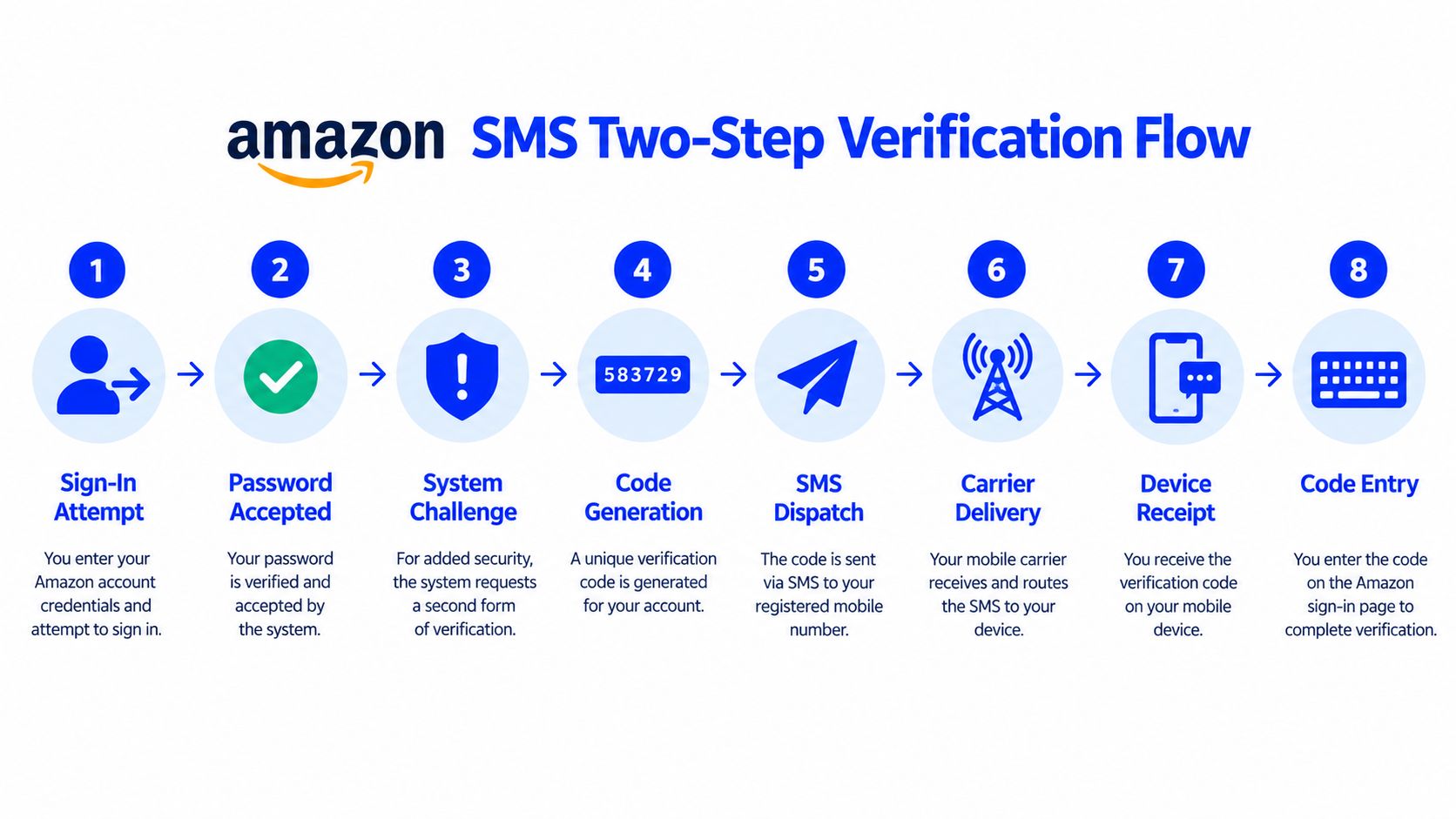
Amazon's help documentation says an OTP is valid for 10 minutes and recommends checking the network connection, updating the phone number in Login & Security, clearing the message inbox, restarting the phone, and confirming Amazon's number isn't blocked when a code is missed. Amazon's missing-code guidance supports treating expiry as part of the normal process rather than repeatedly entering an old message.
The code must correspond to the number and sign-in attempt Amazon is checking. A later request may make an earlier code unusable, so repeatedly tapping resend can create confusion about which message is current. Waiting briefly for the latest request, then using only the newest code, is more reliable than mixing messages.
Amazon also supports alternatives. Its security guide describes an authenticator app and a voice call as backup verification methods when SMS access isn't available. Amazon Pay likewise documents SMS and automated voice call setup, with the user entering a full primary phone number that can receive texts or calls. Amazon Pay's two-step verification instructions distinguish voice delivery from SMS rather than treating them as the same channel.
The broader security context matters too. A resource on strongest MFA methods of 2026 can help readers compare SMS with authenticator apps and hardware-based methods. SMS remains convenient, but the delivery chain includes Amazon, the carrier, and the device. A failure at any point can prevent the code from appearing even when the account and password are correct.
Why a New Number Cannot Recover an Existing Account
A fresh number doesn't become a recovery key merely because it can receive SMS. Amazon associates an existing account's two-step verification with the phone number or other method already enrolled in that account. A number that was never linked has no matching record for the original sign-in challenge.
That distinction separates new-account verification from existing-account recovery. During a new sign-up, Amazon may ask for a number that can receive a verification message. During recovery, Amazon needs evidence connected to the existing account, such as the enrolled phone, an authenticator method, backup codes, or the recovery process Amazon makes available.
A new SIM, virtual number, or secondary line therefore can't generate a valid OTP for an old account just because it belongs to the same person. The code is generated for the account's configured verification channel, not for any number selected later.
When a different number can help
A different number may be appropriate in two limited situations:
- New account setup: The number can receive a verification message for an account being created, subject to Amazon's current requirements.
- Post-recovery account maintenance: Once the account holder has successfully verified access, Amazon may allow a replacement number to be added through Login & Security.
The second situation is a change to the account, not a shortcut into it. If the old number is lost, the practical route is to use an already configured backup method or Amazon's official account-recovery process. A paid verification number can't bypass an identity check, account restriction, CAPTCHA, ban, or unsupported number-type rule.
A replacement number helps after account ownership has been established. It doesn't establish ownership by itself.
Official Troubleshooting When the Code Never Arrives
A missing code deserves a controlled checklist, not an endless sequence of resend requests. Amazon's help instructions point to the phone, account settings, message handling, and alternative verification methods as the main areas to check.
Start with the device. Confirm that it has a working network connection and can receive ordinary SMS messages. If other texts also fail, the problem may sit with the handset, SIM, carrier service, or coverage rather than Amazon's login page.
Next, open Login & Security through an already available trusted session and verify the stored phone number. Check the country code and digits carefully. A number that looks correct on the phone may still be different from the number Amazon has enrolled.
A practical order of checks
- Check the inbox: Clear space if the device cannot accept new messages, then restart the phone.
- Inspect blocking controls: Confirm that Amazon's sending number, short code, or message route isn't blocked. Review carrier spam filtering and third-party SMS-blocking apps.
- Use the newest request: If the first message is late, avoid entering it after a replacement request has been made. Use the most recent code before its 10-minute validity window closes.
- Choose another method: Amazon Seller Central's help explains that the “Didn't receive the code?” link can show configured backup methods, and that a voice call may be available when SMS doesn't arrive. Amazon Seller Central's verification-code guidance treats voice as a separate fallback.
- Try an authenticator app: If one was configured earlier, it can avoid the SMS delivery path entirely. It can't be activated retroactively as an instant substitute for a locked-out account.
- Escalate recovery: If the enrolled number is inaccessible and no backup method works, stop treating the issue as a delivery glitch. Use Amazon's official account-recovery route rather than continuing to request codes.
For readers comparing SMS troubleshooting with broader verification issues, this guide to receiving SMS verification codes provides adjacent context. It shouldn't replace Amazon's own recovery process, especially when the account is already tied to a different number.
Unexpected Codes, Phishing, and SIM Risk
An unsolicited Amazon OTP text usually means someone initiated a sign-in or verification attempt involving the account or phone number. It doesn't prove that the person succeeded. The purpose of the second factor is to stop the login unless the attacker also obtains the code.
The danger often begins after the message arrives. A scammer may send an email or text claiming that an account has unusual activity and direct the recipient to a look-alike sign-in page. The page may ask for the Amazon password and the current OTP, allowing the attacker to use both during a genuine login attempt.
Signals that deserve caution
- No matching login: If nobody in the household tried to sign in, the code should be ignored.
- Urgent follow-up: Pressure to “verify now,” call an unfamiliar number, or click a link is a common phishing pattern.
- Unexpected requests: Amazon support shouldn't need an account holder to disclose an OTP to a stranger.
- Sender uncertainty: A familiar-looking sender name doesn't make a linked website genuine. The account holder should open Amazon directly instead.
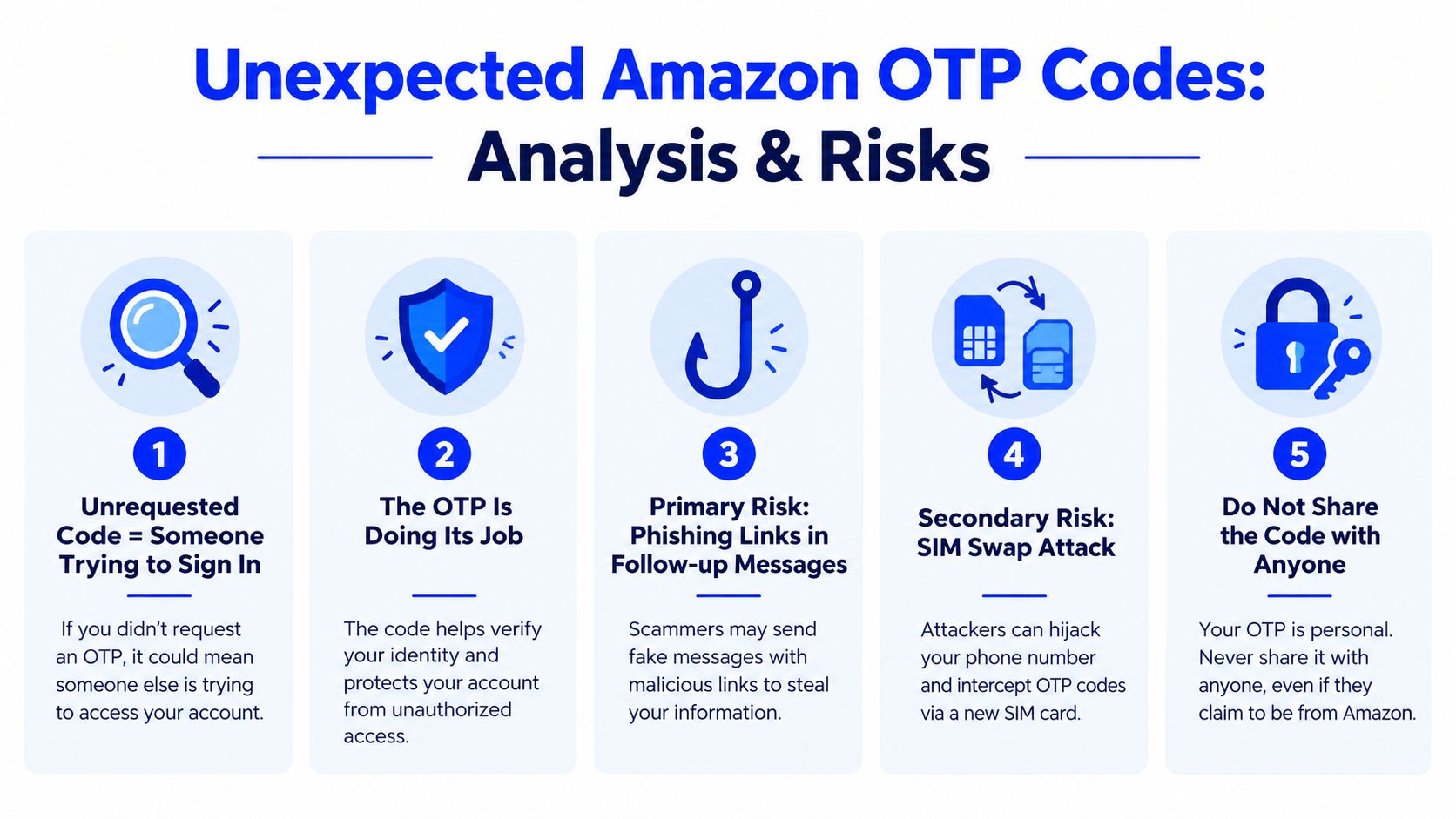
SMS also has a structural weakness. Research on SMS-based OTPs describes interception, man-in-the-middle attacks, and message compromise, because security depends on the mobile network, SIM, handset, and delivery path. Research on SMS OTP security risks supports moving high-value accounts toward an authenticator app or phishing-resistant hardware method where Amazon supports it.
A SIM-swap attack can redirect messages after an attacker persuades a carrier to move the number to another SIM. Sudden loss of mobile service, unexpected carrier notices, or Amazon messages for an account the recipient doesn't recognize should prompt a direct carrier check and an Amazon security review.
For a concise explanation of the code-sharing threat, this SMS verification code guide offers related reading. The central rule remains simple: an unrequested code should never be forwarded, pasted into a page reached from a message, or read aloud to an unsolicited caller.
Choosing a Number That Fits Your Verification Goal
Number choice depends on the account's purpose and recovery needs. The personal SIM, a separate private line, and a paid temporary verification number solve different problems, and none should be treated as interchangeable.
| Option | Best For | Key Strength | Key Limitation |
|---|---|---|---|
| Personal SIM | One primary Amazon account used long term | Direct control and familiar recovery access | Exposes a personal number to the account and remains vulnerable to phone or SIM loss |
| Secondary private line | Separating personal and seller activity | Keeps recovery access on a dedicated number under the account holder's control | Requires ongoing access and careful account maintenance |
| Paid private SMS-verification number | Supported new-verification or bounded testing workflows | Separates a verification step from a personal number | May be temporary, SMS-only, offer-dependent, and not suitable for account recovery |
A personal SIM is usually the clearest fit for a single long-term account. A secondary private line can make sense when a user wants separation between personal activity and authorized business or seller work, provided the line remains accessible for future recovery.
A paid private verification number is a narrower tool. LineVerifier lets customers select a supported service and country, review the current offer and price, use the assigned number for an SMS verification flow, and retrieve the message through its dashboard. Availability, number type, access duration, and refund eligibility depend on the selected offer and current terms. Receiving an SMS doesn't mean the number supports voice calls or serves as a permanent personal phone line.
Free public numbers create additional uncertainty. Shared inboxes can expose codes to other users, previously used numbers may already be associated with accounts, and Amazon may reject unsupported or unsuitable number types. Carrier filtering, number reputation, country-code formatting, and platform rate limits can all affect delivery. A vendor-independent guide identifies issues including short-code blocking, an existing Amazon association, formatting errors, repeated-request limits, and a rough cap of about 10 SMS attempts in 24 hours. Common Amazon OTP failure causes provide useful context, but current Amazon rules and the selected offer remain controlling.
For background on the distinction between temporary and virtual lines, this explanation of virtual phone numbers can help. The decision rule is practical: use a number the account holder can control for recovery, and use a temporary option only when the workflow doesn't require long-term access.
Putting It All Together
An Amazon OTP text is a temporary checkpoint, not proof that an account has been compromised and not a replacement for account recovery. The account holder should confirm the enrolled method under Login & Security, check connectivity and message blocking, use the latest code within its validity window, and switch to voice or an authenticator method when Amazon offers one.
An unsolicited code should be treated as a warning. The recipient shouldn't click a follow-up link, share the code, or respond to a caller claiming to provide support. For seller accounts facing a separate operational or appeal issue, Amazon seller drop shipping help may provide relevant specialized context, but it doesn't replace Amazon's verification process.
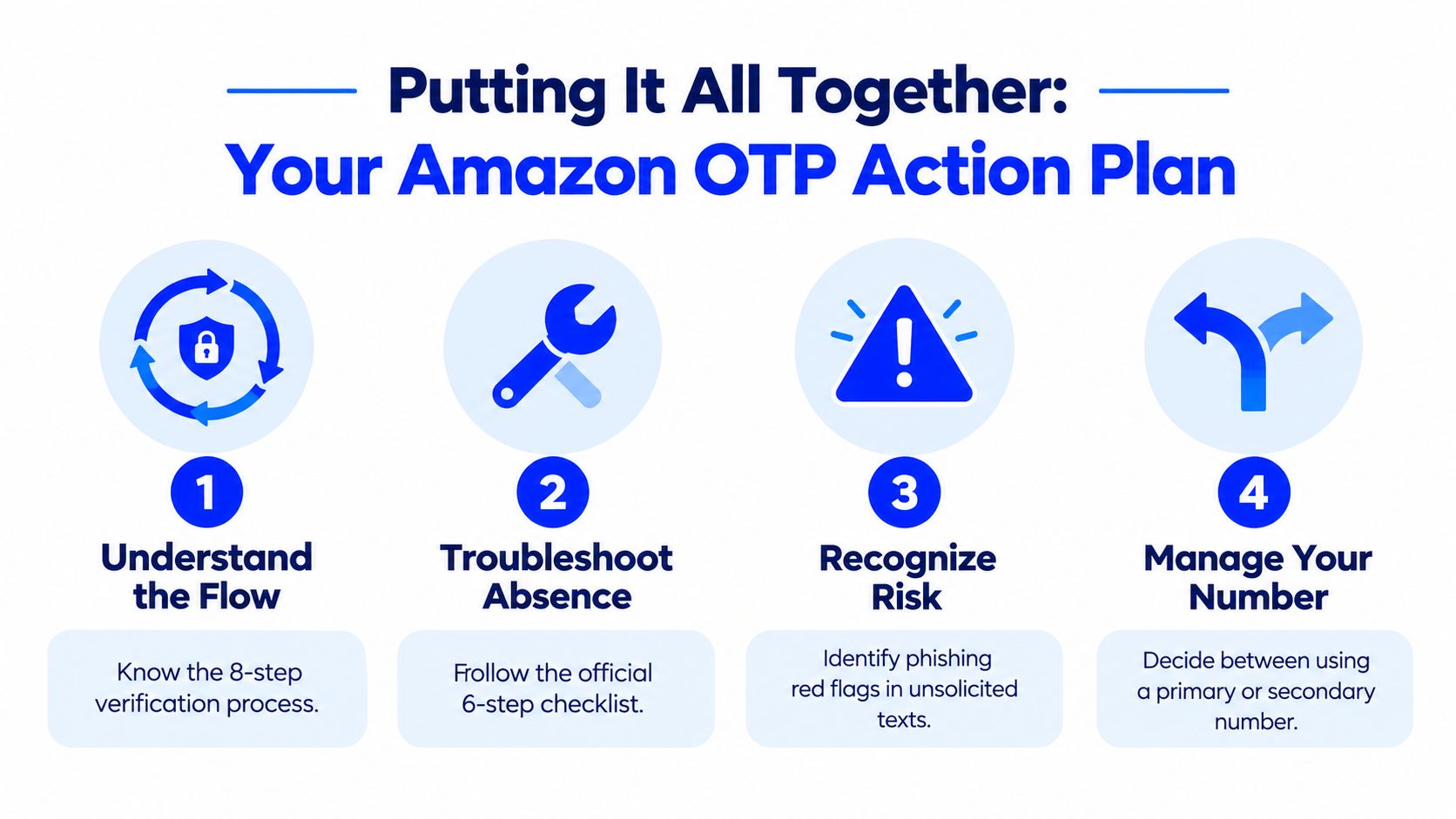
For a long-term account, a controlled personal SIM or secondary private line is more appropriate than a temporary number. A paid verification number fits only a clearly bounded, authorized new-verification or testing task. If recovery is the goal, return to the original number, use a configured backup method, or contact Amazon, because an unrelated new number won't resolve access for an account bound to the old one.
LineVerifier provides paid SMS verification offers for supported services and countries, with the current number type, price, access duration, and eligibility terms shown before use. Visit LineVerifier to review the available option for a legitimate verification workflow, and keep a separate recovery method under the account holder's control for any account that must remain accessible.